How Much Are Container Ship Pools? Complete 2026 Cost Breakdown & Buyer’s Guide

Shipping container pools – backyard “pools” made by upcycling shipping containers – are increasingly popular for their modern, portable aesthetic and eco-friendly appeal. These 8–12 foot-wide metal pools fit in tight urban yards (even alongside tiny homes) and can be moved with you if you move, unlike permanent gunite pools. As an alternative pool solution, container pools are quicker to install and often more insulated than concrete or vinyl liners. However, costs still run into the tens of thousands, and factors like site prep, crane rental, and local permits add up. This 2026 guide breaks down all costs, sizes, materials, and installation options for container ship pools – answering questions like “How much does a container pool cost?” and “Is it worth it?” with up-to-date data and expert tips.
Average Cost of Container Ship Pools in 2026
In 2026, a shipping container pool (including delivery and basic installation) typically runs $35,000–$65,000 on average. Industry data show a national average around $50,000. This aligns with multiple sources – for example, HomeGuide reports most homeowners spend about $50K total for an 8×20 container pool. However, costs vary widely. A stripped-down above-ground container “pool kit” can be as low as $15,000–$25,000 for a DIY project, while a fully custom, in-ground modular setup (multiple containers joined) can approach $80,000–$100,000+. Factors such as pool size, site complexity, features (windows, tanning ledges, LED lighting, spa heaters), and local labor rates all influence the final price. Generally, container pools are more affordable than a high-end gunite or fiberglass pool, but more expensive than a simple above-ground kit.
In practice, “bare bones” container pools (small size, basic liner, minimal features) can start around $20–$30K. Mid-range 8×20 installed pools typically cost $30–$45K. Larger 8×40 models often run $40–$60K installed. Adding customizations – a glass side window, exotic interior colors, built-in hot tub section, or advanced smart controls – can quickly add several thousand more (see Price Factors below). As one industry overview notes, “Prices range from $15,000 for a bare-bones aboveground pool to $100,000 for a fully customized in-ground pool with high-end features.”.
Container pools are also sold used or as kits. Used shipping container pools can sometimes be found well under new prices, but beware of corrosion, liner damage, or missing equipment. DIY container pool kits (raw container plus a liner and hardware) typically cost $10,000–$30,000, depending on design complexity. For example, BoxHub reports that simple kit-based projects “could cost under $20,000 to install,” whereas elaborate designs or professional packages easily exceed $30K. (Keep in mind that DIY builds often require excavation, permits, and expert welding – see Installation below.)
Overall, you should plan for $30K-$50K+ for a standard new container pool, and more if you need complex installation or add-ons. Even if you search for “container pools for sale near me,” expect similar ranges. In short, container pools can start around $28K and go up to $50K or more installed, with custom systems beyond that range.
Container Pool Cost by Size
Container pools come in a handful of standard sizes (almost always 8 feet wide, and 12–40 feet long), plus some wider 12-foot models or modular combos. Typical price ranges by size (pool shell only, not including delivery/installation) are shown below:
| Pool Dimensions | Base Price Range | Approx. Installed Cost† |
|---|---|---|
| 8×12 ft | $26,000 – $41,000 | ~$30K – $45K (smaller capacity) |
| 8×20 ft | $28,000 – $50,000 | ~$35K – $50K (medium size) |
| 8×40 ft | $45,000 – $80,000 | ~$55K – $80K (large, lap pool) |
| 12×20 ft | $30,000 – $56,000 | ~$35K – $60K |
| 12×40 ft | $50,000 – $85,000 | ~$60K – $90K |
| Modular | $$$ (custom) | $$$ (varies with configuration) |
*Prices for pool unit only, before delivery/installation.
†These are very rough installed costs (pool + labor) and can vary widely.
For example, a 20-foot container pool (about 5,000–6,000 gallons) often costs around $30K-$45K total installed. A 40-foot pool (10,000+ gallons) is substantially larger and typically runs $50K-$75K installed. Widening to 12-foot (uncommon) adds cost as well. Connecting multiple containers (modular pools, e.g. L-shapes or lap pools) is a luxury option – prices can exceed $100K once you add up multiple shells and extra plumbing.
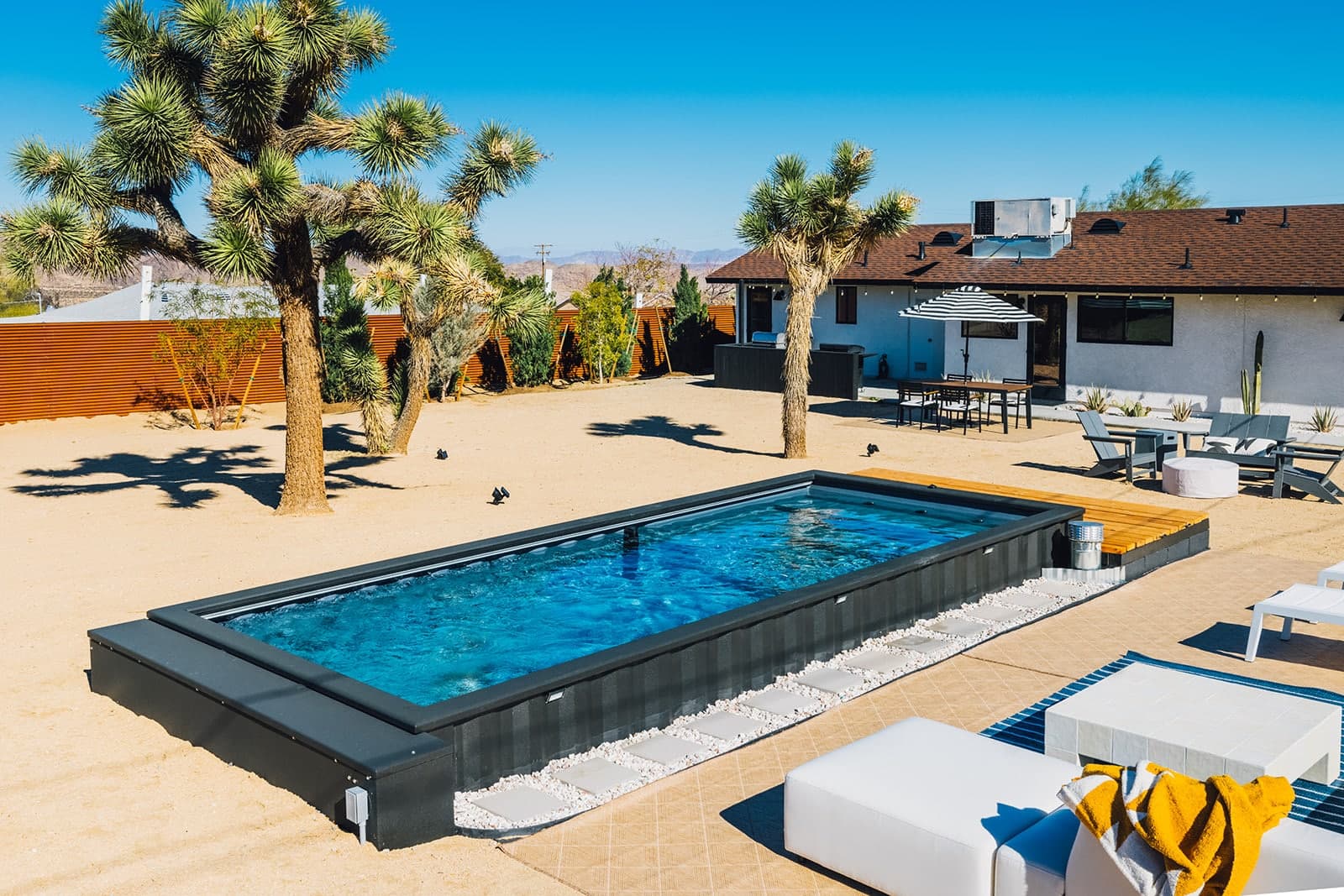
Modern brands even offer expansions (like a small attached spa section). For instance, pools with integrated spa jets or hot-tub sections cost several thousand dollars more (see Cost Factors). Similarly, adding a full-width glass wall (see image below) typically adds $3K–$8K per window.
Overall, size is the most important cost driver. Double the length roughly doubles material and labor costs. You can get a fairly basic 8×20 pool for well under $50K installed, but going to 8×40 or beyond quickly pushes the price toward $80K or more.
(Bottom line: 40 ft container poolscost tens of thousands more than a compact 20 ft model.)
Price Factors & Cost Drivers
Several factors can dramatically affect the final container pool price:
Size & Volume
As noted,
bigger = costlier. Larger containers use more steel (higher base price) and weigh more, requiring more expensive transport and possibly a larger crane. For inground installs, a larger pool also means more earth to excavate. (Leverage our size chart above for quick estimates.)
Installation Type (Above vs In-ground)
An
above-ground container pool sits on a level surface or slab, minimizing excavation and labor. These are cheapest to install. Digging even a few feet (semi-inground) adds excavation and potential retaining walls. A fully
inground installation adds the most cost – you must dig a large hole, possibly shore up the walls, hire a crane to set the pool, and backfill. We discuss the breakdown below, but plan on
thousands more for excavation and a crane compared to a simple above-ground placement.
Foundation & Site Prep
All installations require a stable foundation: typically a compacted gravel base or concrete slab (at least a few inches thick). Leveling the ground can cost $0.50–$2 per sq. ft, and a 20×20 ft concrete pad might be $2,400–$4,800. Some companies (like Midwest) specify
3″ concrete slab or footings under the pool. If your yard needs grading, fill dirt, or blasting bedrock, your costs will rise (fill dirt is ~$150–$600 per truckload).
Structural Reinforcement
A filled container pool exerts enormous pressure on its walls. Most prefab units include steel reinforcements, but in some cases additional braces or foundation beams are needed. In-ground pools especially often require extra underpinning (e.g. engineered footings) which could add ~$1,000–$3,000. Ensure your installer addresses this – it’s critical for safety and longevity.
Liner/Interior Finish
The container’s interior must be made watertight. Options include simple paint (metal corrosion coatings), drop-in fiberglass shells, vinyl liners, or advanced membranes. Painted steel interiors are cheapest but
not recommended – owners report rust issues (often within 1–2 years) and rough surfaces. Fiberglass shells (a rigid fibreglass liner installed inside) feel nice but can crack if ground shifts. Many experts favor a welded polymer membrane (like Ecopool’s “Zycore™” system) for its durability and smooth finish. Upgrading from basic paint to a quality liner can add several thousand dollars to the base price.
Waterproofing & Coatings
Beyond the liner, pools often get additional waterproofing (epoxy/urethane coatings) especially on the tank exterior or top edges. These are usually included by prefab suppliers, but DIY converters must budget for them. Skipping proper coating is a common mistake.
Excavation, Landscaping & Permits
If going inground, excavation alone can be $500–$3,000 depending on soil conditions. Don’t forget permits: many jurisdictions treat a container pool like an in-ground pool. For example, Nassau County, FL requires a permit for any pool over 5,000 gallons (about an 8×20 container). Check local rules (some places require fencing, bonding inspections, etc.). Also consider drainage or retaining walls – any site modifications add cost.
Crane Rental/Delivery
A shipping container pool is heavy (a
20ft container pool can weigh 4–5 tons empty). Delivery and placement usually require a crane or telehandler. Crane rental plus an experienced operator can easily run
$1,000–$3,000 or more depending on local rates and lift height. (Exact quotes vary; your installer should itemize this.)
Access & Transport
If your yard is hard to reach, expect higher transport/delivery fees. Tight turns or long carry distances may incur premium charges from trucking companies. Remote areas also add mileage costs.
Add-Ons & Features
Many container pools offer optional upgrades, which can add up:
- Windows/Glass Walls: Typically
$3,000–$8,000 per viewing window.
- Lighting: LED underwater lights cost a few hundred each; full perimeter lighting packages can be a few thousand.
- Heaters/Hot Tubs: Adding a built-in hot tub section or heat pump may add $5K–$15K (Spa-divider kits alone are ~$2–3K, plus plumbing/heater equipment).
- Filtration/Automation: High-end filters, variable-speed pumps, salt systems, and smart controllers can add $2K–$6K. (For reference,
Midwest Container Pools offers a Pentair salt chlorine system for ~$1,977.)
- Decking & Coping: Composite decking around the pool edges and stairs could run $5K–$15K depending on layout and materials.
- Cover: Automatic pool covers are $4K–$10K. Manual safety covers run a few hundred.
- Electrical/Plumbing: If not included, you may need an electrician and plumber to hook up the pump, heater, and lights (often a few hundred per trade, or an all-in $1K–$2K labor).
Brand & Quality
Well-known container-pool brands typically charge more but offer reliability. For example,
Trek Pools and
ModPool are on the higher end (their 20ft models often start in the $30–40K range). Mid-tier brands like
Ecopool advertise starting around $30K. Lesser-known builders or kits might be cheaper initially but could incur extra costs later if issues arise. Investing in a reputable installer can prevent costly mistakes.
All these factors mean your final cost could be quite different from the base pool price. To keep it organized, here’s a quick Price Factors checklist:
- Pool Size & Shape: Longer/wider = higher material and crane costs.
- Installation Type: Above-ground (cheapest) vs. semi-inground vs. fully inground (excavation + crane).
- Foundation: Concrete pad or engineered footings (slab or piers).
- Liner Type: Paint (avoided), fiberglass shell, vinyl liner, or welded membrane – each has a different price.
- Site Prep: Grading, drainage, retaining walls, utility extensions, etc.
- Permits/Engineering: Building permits, electrical/gas permits, soil tests, land surveys if required.
- Crane & Delivery: Large transport trucks, lifting equipment, especially for inground.
- Add-Ons: Windows, tanning ledge, built-in spa, heating, lighting, covers, etc. (Each typically $500–$8,000+).
- Filtration & Equipment: Quality pumps/filters/heaters can add thousands. (E.g. Midwest includes a Hayward filter and Pentair LED light.)
- Brand/Manufacturer: Premium brands and fully-welded units cost more than basic kits.
- Labor: DIY vs professional – labor is ~25–50% of total project cost.
By understanding these drivers, you can see why bids vary so much. When comparing quotes, ensure like-for-like (same size, liner type, and features) and ask contractors to itemize these factors.
Interior Material Comparison: Steel vs Fiberglass vs Vinyl/Membrane
A critical decision is how the pool’s interior is finished, since the original container walls are not waterproof or smooth. There are three main approaches:
Painted Steel (Avoid):
This is the cheapest “liner,” basically paint or epoxy sprayed directly onto the corrugated steel. It holds water at first, but most experts warn against it. Owners report
rust bubbling through in a year or two, especially if any small punctures or scratches appear. Painted steel also ages poorly – coatings can chip or become rough, potentially cutting swimmers. In short, painted container pools are prone to failure and costly repairs.
Fiberglass Insert:
A prefabricated fiberglass pool shell (like an above-ground pool insert) can be dropped into the container. Fiberglass is smooth and hides rust, but it must be engineered for container use. The downside:
if the shell cracks or delaminates (from ground shifting or temperature swings), repair is very expensive. Pool Nerd notes that a crack in a fiberglass insert can cost “thousands of dollars” to fix. Installation also requires perfect tolerances. Many manufacturers actually
drop-in a fiberglass liner and then weld extra supports around it. While better than paint, fiberglass liners can fail in extreme conditions (e.g. seismic zones).
Vinyl/Polymer Membrane (Recommended):
The most modern solution is a welded vinyl or polymer
architectural membrane. These membranes (such as Ecopool’s “Zycore™” or similar systems) are heavy-gauge pool liners that are heat-welded on-site. They adhere to the steel but remain flexible and smooth. If damaged, a membrane can be patched without replacing the whole liner. Owners praise them as feeling like tile or plaster
without the maintenance – no sharp edges and extremely low algae growth. High-tech membranes can even be 3D-printed or patterned, so your pool can look like stone or mosaic tile.
In summary, avoid bare painted steel – it will likely fail. Fiberglass liners are an option but carry fracture risk. For best longevity and a premium feel, a welded vinyl/membrane liner is advisable. (This choice may cost a bit more initially, but it pays off in durability and lower maintenance.)
Installation Cost Breakdown
Above-Ground Installation:
The fastest and simplest method is to place the container on a prepared slab or gravel base above ground. In this case, you only pay for minimal site prep. Labor typically involves leveling the ground, pouring the slab (if needed), and plumbing the system. An above-ground install may require only a few laborers for a day or two. Estimate installation labor at around 10–20% of pool cost (e.g. $5K–$10K on a $40K pool), plus any slab ($2K-$4K for 20×20 ft) and dirt work. There is usually no heavy excavation or complicated shoring, so above-ground installs are often the most affordable route.
Semi-Inground Installation:
Many homeowners prefer to sink the pool partway (2–4 feet deep) so it isn’t a big box on the lawn. Semi-inground requires some excavation and often building a short retaining wall around the exposed portion. Expect to pay for 2–4 feet of digging around the footprint. Excavators rent for roughly $100–$300 per hour, so even one day of digging ($2K–$4K) is significant. If your yard is sloped, you may need additional landscaping. In return, the pool looks integrated. Costs are higher than above-ground but still below full inground.
Fully Inground Installation:
For a flush, in-ground look, contractors dig a hole the full height of the container (8.5–9.5 ft plus decking height). This is essentially a standard pool excavation. It typically involves: land survey ($200–$1,200), soil tests ($1K+), hundreds of cubic yards of dirt removal ($150–$600/truck), plus retaining walls or shoring if needed. After digging, a crane must lift the heavy pool into place. Crane rental with operator can easily run $2,000–$5,000 (depending on location and crane size). Finally, the hole is backfilled around the container with gravel or sand. Labor for these steps, plus finishing (plumbing, deck coping, landscaping), often adds $10K–$20K or more to a project.
To illustrate with an example:
installing an 8×20 container pool above-ground might add ~$5K-$10K in labor/equipment, whereas doing it fully inground can add $15K–$30K when you factor in excavation, crane, walls and backfill. Some professionals quote that going from above-ground to inground can double the installation cost. In either case, plan on hiring experienced pool contractors (typically $50–$150/hr) or heavy-equipment operators. Don’t attempt a large inground install alone – mistakes could cause structural failure.
Crane Costs:
While not often listed explicitly, the crane is a big line item. For reference, a small crane rental might be $1,000–$2,000 for a day, and larger cranes (needed if site access is tricky) can be several thousand more. Always ask your installer to specify crane fees. Even above-ground installs might need a small lift into place.
DIY vs Professional Installation Cost
Given the high labor component, you might wonder about a DIY container pool. Purely DIY routes exist: you can buy a used 40ft container pool (~$5K–$8K) and retrofit it, or buy a kit (container + liner + pump) for $10K–$30K. A savvy homeowner could then handle excavation, liner installation, plumbing, and electrical. BoxHub estimates that a full DIY pool could be under $20,000 total if you do all the work. Labor (and thus total cost) can be halved by DIY labor, as labor is roughly 50% of a pool’s cost.
However, there are major caveats. Converting a container is more complex than assembling a kit; it involves welding structural supports, ensuring waterproof seals, and installing regulated electrical/gas systems. Mistakes (like uneven foundation or poor welding) risk leaks or collapse. HomeGuide warns that while an experienced DIYer could install an above-ground container kit, most people should hire pros to ensure it meets code and lasts. In general:
- DIY Cost: ~$10K–$25K (basic kit and tools) plus materials for site prep and utilities. Be prepared to spend many weekends and possibly hire heavy equipment rentals. Permit fees still apply.
- Professional Cost: Expect to pay 25–50% of project cost on labor. On a $50K total project, that’s $12K–$25K in labor. Pros handle permits, inspections, and complex tasks (welding, crane operation) safely.
Most reviews suggest that unless you have contracting experience (or want a true weekend project), it’s wise to use professionals for container pool installation.
Long-Term Maintenance & Operating Costs
Once your container pool is installed, ongoing costs are modest but real. Factor in chemicals, heating, electricity, and routine upkeep. On average, expect $1,000–$2,000 per year in operating expenses, broken down roughly as follows (based on typical pool data):
- Chemicals & Water: Expect to spend about
$300–$600/year on chlorine/salts, shock, pH balancers, etc. Notably, insulated container pools often use
less chemicals than rough plaster pools. The Pool Nerd reports their insulated membrane pool used about $40/month in summer and $20 in winter, roughly
15–20% fewer chemicals than a similar concrete pool.
- Electricity: Pump and possibly heater. Studies show pools burn
$300–$1,300 annually on electricity (depending on size and climate). Luckily, container pools’ insulation (often R-8 to R-10) means they hold heat much better. In fact, they lose only ~0.4–0.6°F overnight vs ~2°F for a gunite pool, so your heater runs less. Still, budget at least
$300–$700 for pump and light power. If you add a gas or heat-pump heater, that’s more (maybe $500–$1,000 extra per season for heating in a cool climate).
- Equipment Maintenance: Plan to replace the pool filter cartridge or sand every few years (~$100–$500) and pump parts as needed. A multiyear pool cover (if any) may cost $300–$1,000. Filters can be salt-friendly (many container pools use standard Hayward or Pentair systems – e.g. Midwest’s kit includes a Hayward cartridge filter) or replaceable media.
- Heating Fuel (if used): Gas or electric heater operation might add
$200–$500 per season on top of pump power. Insulation cuts this compared to concrete pools.
- Water: You’ll refill annually or when leaks occur. A 20ft container holds ~8,700 gallons, which at ~$0.004/gal is about $35 to fill. Minor, but if you drain annually for maintenance, it adds up.
- Professional Maintenance (optional): If you hire a pool service, add ~$1,000/year. Otherwise, DIY owners typically spend 1–2 hours/week on chores.
Angi’s research suggests setting aside $960–$1,800 per year for typical pool maintenance. Container pools may sit at the lower end of that range due to less heating cost and chemical use. Don’t forget winterizing (closing the pool) in cold climates ($150–$300) and opening costs ($150–$400).
In summary, container pool ownership does carry ongoing costs (chemicals, utilities, minor repairs), but these are similar to a standard in-ground pool – often even a bit lower thanks to good insulation. For budgeting, estimate about $100–$200 per month when in use (summer) and less in winter, plus occasional maintenance line items.
Container Pools vs Traditional Pools
How do container pools stack up against traditional in-ground pools? Here are the main comparisons:
- Cost: Container pools typically fall
in the middle. A basic traditional above-ground vinyl pool might be $2–$5K, while a midrange in-ground (fiberglass or plaster) can easily be $40–$60K. Container pools ($35K–$65K installed) often cost
less than a fully custom gunite pool, but
more than a simple backyard above-ground pool. (For example, ModPool notes a 35K price is about
one-quarter the cost of a high-end in-ground pool.)
- Installation Time: Container pools are
faster. The prefab shell is built in a factory, and on-site work is often measured in days (plus ground prep) rather than months. Above-ground installs can be done in one week. In contrast, a traditional inground pool usually requires several weeks of excavation, curing plaster, and finishing.
- Durability: Containers use
galvanized steel, which is very strong structurally. They can last decades – many owners report 20–30 years, especially if kept coated. However, steel will rust if not properly lined/protected. Concrete pools last long but can crack, and standard above-ground pools use lighter materials (steel or resin) that may not last as long.
- Heat Loss: Thanks to their insulated walls (many container pool brands use 7–10” of insulation), these pools
lose heat very slowly. Gunite pools (no insulation) lose temperature quickly to the ground. This means container pools typically
hold warmth longer, saving on heater costs.
- Aesthetics: Container pools offer a distinctive
modern, industrial look. They fit well in contemporary landscapes or tiny-home settings. Traditional pools allow
any shape – curves, custom tiles, etc. Container pools are rectangular (8–12 ft wide) by nature, though some brands do allow 12-ft models or multiple units for L-shapes. If you want a freeform design or a large play area for diving boards, a standard pool might win.
- Portability: Big advantage – a container pool can potentially be relocated (lifted out and moved to a new property). A concrete pool is permanent. This makes containers appealing for rentals or future moves.
- Maintenance: As noted, container pools often have
smoother, non-porous interiors (membrane liners) which resist algae. That can cut down on scrubbing and chemical use. Concrete/plaster pools are rougher and can harbor algae, requiring more maintenance.
- Space Requirements: Traditional pools usually need a wider area. An 8×20 container pool only needs about 10×25 ft of yard for a proper deck around it. A comparable rectangle concrete pool would need more clearance. This makes containers great for tight spaces or side yards.
In short, container pools are a trade-off: you get a portable, quick-install, insulated pool in a compact size. They typically cost more than a flimsy above-ground pool but less (or comparable) to a finished in-ground pool, especially when considering how many features come standard (stairs, lighting, etc.). They do come with limitations (no curved shapes, less diving depth, potential rust concerns) – so weigh those against the benefits.
For quick comparison, JackCooper’s table highlights: container pools (~$35–65K, weeks to build, high mobility) vs. traditional (~$25–$100K, months-long, permanent).
Learn More about container pool vs traditional pool
Are Container Ship Pools Worth It?
Many buyers ask: “Is a shipping container pool worth the investment?” The answer depends on your needs and values.
Pros: Container pools often cost less than a comparable inground pool and install much faster. They’re built with thick steel walls and factory-fab construction, which can boost durability. They’re also portable (you can theoretically take it with you on a move) and are very eco-friendly (reuses steel, often packaged in recycled form). Quick construction means your backyard disruption is minimal. Many owners find they even raise home value by adding a unique pool. If you want a modern, clean-lined backyard oasis and have the budget, a container pool delivers a lot of pool for your money (with integrated lighting, steps, etc.).
However, cons are real. The size/shape is limited (long rectangles only – not ideal for diving or pool slides). If you crave curves or a freeform lagoon look, skip it. Because they’re steel, they can rust over time if the liner fails. Not all container pools are insulated – cheaper models might be just metal, making heating more expensive. Speaking of heating: while insulated containers save energy, a large heated spa section will still run up your utility bills, so factor that in. And unlike a simple inflatable or above-ground pool, container pools are not “cheap”; they carry tens of thousands of dollars in costs.
In terms of lifespan, a well-built container pool should last 10–30 years or more. The variance comes from the container’s condition: a brand-new “one-trip” container will outlast a rust-beaten 10-year-old box. Proper maintenance (keeping the liner intact, covering the pool in winter, etc.) is key.
So: Are they worth it? If you want a solid pool, limited space, quick install, and modern style, many homeowners say yes. The long warranties and up-front price (often 50% less than gunite) can make them attractive. If your priorities are extreme customization, maximum depth, or rock-bottom price, a container pool may feel restrictive.
Learn More about Are Container Ship Pools Worth It?
Ultimately, weigh the features you get (insulation, portability, turnkey pool with equipment) against features you lose (shape flexibility, maximum size). As one summary notes, container pools are “environmentally friendly, cost less than most inground pools, and require much less time to install” – but they aren’t great for divers or large gatherings.
Buyer’s Guide & Checklist
Planning a container pool? Use this checklist to cover all bases:
- Measure Your Space: Ensure you have at least 8×20 ft for a standard container pool (plus room for decking, a heater, and pump equipment). Allow extra workspace for the crane and contractor access. For tiny backyards, even an 8×12 plunge pool is possible.
- Check Codes & Permits: Treat the pool like a regular pool. Contact your city/county building department. You likely need a
pool permit, especially for in-ground or electrical work (some areas require permits for pools over 5,000 gal). Also check HOA rules on pool installation.
- Decide Installation Type: Will it be above-ground, semi, or fully inground? Above-ground is cheapest; inground gives a sleek look but costs more. Semi-inground is a middle path often used to meet HOA aesthetics.
- Prepare the Foundation: Plan for a
level, sturdy base. Most installers will want either a concrete slab (3–4″ thick, often $6–$12/sqft) or engineered footings. If you’re doing gravel, compact it well. No matter what, skip uneven soil – you don’t want the pool settling and warping.
- Plan for Cranes/Delivery: Ensure your yard is accessible by a large truck and crane. Know where the crane can sit. Ask the installer to include crane rental costs. If your access is tricky, get a surveyor or engineer to advise.
- Finalize Pool Specs: Choose your pool shell model (8×20, 8×40, 12×20, etc.) and finish. Select interior (fiberglass vs vinyl membrane) – we recommend a welded vinyl liner for ease of maintenance. Decide if you want features like tanning ledge, interior bench, or split-level seating.
- Plumbing & Equipment: Confirm what comes with the pool. Many packages include pumps, filters, lights, and skimmers (for example, Midwest’s pools include a Hayward filter and Pentair LED light). Determine if you’ll use saltwater chlorination (Midwest offers a salt system for ~$1,977) or traditional chlorine. If you want solar or heat pump heating, budget separately (Midwest heat pumps cost ~$4,656).
- Contractor vs DIY: Decide if you’ll hire pros. If you’re not an experienced builder, professional installation is safer. Compare quotes from companies that have done container pools before. Verify they’re licensed and insured. Avoid suspiciously low bids – quality matters for a long-lasting pool.
- Ask the Right Questions: When vetting installers, consider HomeGuide’s advice: ask about their experience, container origin (new vs used), site prep standards, and included features. Also ask about warranty terms and maintenance support. Make sure all permits are handled.
- Budget for Extras: Remember the little costs: testing and balancing chemicals, summer monthly maintenance, and occasional parts (pump belts, light bulbs). Plan ~$1K/yr as noted. Also consider adding a pool cover or fencing for safety.
- Plan for Utilities: If you need to bring electricity or gas to the site, plan that into costs. Often a dedicated 220V line is needed for pumps/heater. If you use a gas heater, include pipe installation.
- Prepare for Weather: If you live where it freezes, choose a method to winterize the pool. Cover it and maybe hire a pro to winterize every year (about $200–$300).
By following this checklist, you’ll avoid surprise costs. Do your homework, get multiple quotes, and ensure you’re comparing similar packages (same size, liner, pump, etc.).
FAQ
Q: Is a shipping container pool worth it?
A: It can be, if the benefits align with your goals. Container pools are cheaper and faster than many traditional pools. They install quickly, use durable steel, and can be insulated to save energy. They also look modern and can fit in tight yards. If you value these things and want a backyard oasis with a unique aesthetic, many owners find them worthwhile. However, they do have limits (fixed rectangular shape, no diving boards, potential rust if not sealed). You’ll pay tens of thousands, so weigh that against a smaller inflatable pool or a larger custom concrete pool. In short: yes if you want a mid-priced, stylish pool that you might move one day; no if you need maximum customization or the absolute lowest cost.
Q: How much does a shipping container pool cost?
A: On average, about $35K–$65K installed. A bare-minimum above-ground setup could be as low as $15K-$25K (DIY kit), while a fully loaded custom system (40ft container pool with spa, deck, heater, etc.) can reach $80K–$100K or more. Most buyers for an 8×20 ft pool end up around $40K-$50K all-in. Remember that this includes delivery and basic installation; additions (like windows or automation) add extra. To get your specific cost, get a detailed quote including size, features, and labor.
Q: How much are container ship pools for sale?
A: New, off-the-shelf container pools are usually priced in the tens of thousands. For example, Midwest Container Pools lists a 20ft model at about $42,960 and a 40ft container pool model at about $57,390 (base prices). Other brands give similar quotes (around $30K+ for a 20ft container pool). Used container pools (or kits) can sell for $10K–$30K depending on condition. Prices depend on the seller, included equipment, and how turnkey the installation is. Always clarify what’s included (pump, filter, lights, delivery) when comparing “for sale” ads.
Q: How much does it cost to put in a shipping container pool?
A: Installation labor (groundwork, crane, plumbing) typically adds 20–50% on top of the pool’s sticker price. For a rough example: a $30K pool might cost $36K–$45K total after installation, while a $50K pool might end up $60K–$75K installed. Above-ground installs (slab-level) add a few thousand; inground installs (excavation + crane) can easily add $10K–$30K. One breakdown from a DIY perspective shows an 8×20 pool base $25–40K, installed ~$30–45K, which aligns with industry data. Labor is a significant portion (about half of total cost), so DIY can save, but only if done correctly.
Q: Are shipping container pools worth it?
A: In summary, they’re worth it if you prioritize quick install, insulation, and modern style, and have the budget of a mid-range pool. They’re less ideal if you need a freeform design or have a very tight budget. For many, the value comes from speed (you can swim within days of delivery) and mobility (you can relocate the entire pool later).
Q: Are shipping container pools cheap?
A: They’re generally not “cheap” in the sense of below-average price. Container pools cost substantially more than a basic above-ground pool and can rival mid-level inground pools. While a kiddie pool might be a few hundred dollars, even a simple container kit runs into the tens of thousands. However, they can be “cheap” relative to high-end custom pools – e.g. a $40K container pool provides many of the benefits of a $80K gunite pool. In short, don’t expect a container pool to cost only a few thousand; it’s a serious investment.
Q: How long do shipping container pools last?
A: With proper installation and maintenance, container pools can last decades. Estimates range from 10 to 30 years. Key factors are container age (new vs old box) and protection. A new “one-trip” container is built to last 25+ years, whereas a heavily used old container might corrode sooner. The interior liner also matters – high-quality membranes or fiberglass extend life. Many manufacturers offer 10-20 year structural warranties. Regular maintenance (keeping the liner intact, addressing rust spots) will maximize lifespan.
Q: What is the true annual cost of container pool ownership?
A: Budget roughly $1,000–$2,000 per year for normal running costs. This includes electricity for the pump/heater ($300–$1,000), chemicals ($300–$500), and minor maintenance. If you hire a service, add ~$1,000. Water heating (if you heat year-round) will be additional. Many owners report spending $40/month on chemicals in summer and half that in winter. Electricity for a pump might be $200–$500 annually, and occasional repairs (pump motor, light) occur. Insulated container pools tend to cost less in heating and chemicals than uninsulated pools. An Angi guide suggests setting aside about $960–$1,800 yearly for typical pool maintenance; container pools would be on the lower end of that due to efficiency gains.
Q: How does the cost compare to a traditional in-ground pool?
A: Container pools usually cost less than a high-end gunite pool but more than a simple above-ground pool. For perspective, a basic inground concrete or vinyl pool runs about $25K–$100K. The average container pool ($35K–$65K installed) fits comfortably into that range, often saving money over a fully-custom spa pool. As noted, some sources say a 40K container pool is about one-quarter the price of an expensive in-ground. On the other hand, if you compare to the cheapest fiberglass pool shells ($20K plus), a container pool can be pricier. Installation speed and portability are intangible benefits. Overall, container pools sit in the middle ground: more affordable than top-tier custom pools but not as cheap as basic kits.
Q: What are the pros and cons of shipping container pools?
A: Pros: They’re eco-friendly (recycled steel) and usually cheaper than comparable inground pools. They install quickly (often in days) with minimal yard disruption. They have thick steel walls for durability and (if insulated) excellent heat retention. Many come with steps, lighting, and filtration as standard. They’re portable – you can move the pool. They often increase property value as a unique feature.
Cons: Shape and size are limited (no curves, and deep end is limited by container height). Not suitable for diving boards or water slides. They’re prone to rust if not properly protected; cheap models might be uninsulated (making heating costly). Saltwater chlorination may not be ideal (steel + salt can be corrosive). Heating (if you want year-round use) still costs money, though less than uninsulated pools. Container pools also require permits similar to regular pools (fencing, safety, etc.). Maintenance: the interior liner must remain intact to avoid leaks/rust. As one homeguide list notes, they last “up to 30 years” with care, so be prepared for eventual major overhauls down the line.
Q: Do you need a permit for a shipping container pool?
A: Yes, usually. A container pool is still a swimming pool in the eyes of the law. You’ll typically need a building permit, and possibly electrical and mechanical permits for pumps/heaters. Requirements vary: some areas grandfather small above-ground pools under general rules, but many require a pool permit for any structure over a certain volume (for example, Florida laws require a permit for pools over 5,000 gallons). You may also need a deck or fence permit for safety barriers. Always check with your local building department before buying. Treat it like you would any new inground pool: plan on submitting plans, doing inspections, and having fencing or alarms as required.
Q: How much does it cost to install a shipping container pool?
A: Installation costs include labor, equipment, and any site work beyond the pool shell price. Roughly, expect
20–50% extra on top of the pool’s base price. For example, Pool Nerd reports a
20ft container pool base ~$25K-$40K, installed $30K-$45K. In other words, think of a 30% markup for professional installation (this covers crane, concrete work, hookups, labor). So a $40,000 pool could become ~$52,000 total. If you do it yourself (saving labor), you might stay closer to the lower end (though remember your time is valuable!). Key costs are excavation (if inground), crane rental, concrete slab, and finishing trades. One rule of thumb is: “Pool shell + 25% = total project” for a typical above-ground install. For inground, add a larger percentage to account for dirt work.